
4 Best Flowers For Attracting Hummingbirds
Do you want more hummingbirds to visit your garden? Take a look at the 4 best flowers for attracting hummingbirds.

This post may contain affiliate links. Please see the privacy policy for details.
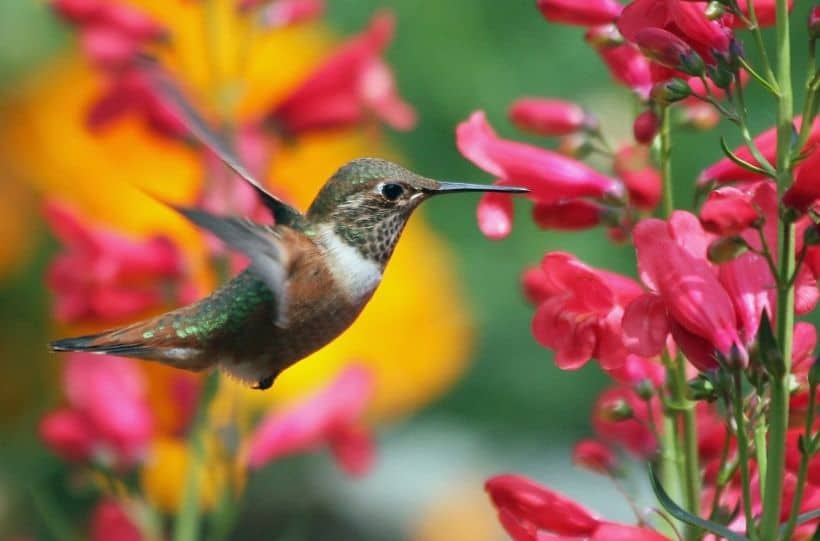
Hummingbirds make excellent garden visitors, not just for their beauty, but also for helping to pollinate your plants. They consume vast amounts of nectar every day and are attracted to gardens where the amplest supply of food is available to them.
If you are fortunate to live in an area native to hummingbirds, it is worth planting some of the best flowers for attracting hummingbirds to your garden.
Not only will you attract hummingbirds, but also a range of other pollinators, such as butterflies and bees, who will also benefit from the flowers planted for hummingbirds.
Before taking a look at which are the best flowers for attracting hummingbirds, there are a few things to consider:
- Choosing Brightly Coloured Tubular Flowers
Hummingbirds are attracted to bright flowers more than any other type. Tubular flowers also often contain more nectar than other varieties and use their colors to attract pollinators such as hummingbirds.
- Select Native Species
Native species are best, firstly, because they are more likely to be widely available in the area you live in. Secondly, because they are native, hummingbirds are more likely to be familiar with them. This means they will prefer these plants to unknown species as they can reliably depend on them for food.
- Perennials
Perennials are ideal for hummingbirds as they return every year, guaranteeing a food source for this pollinator. Though perennials require some care, they generally do not need much maintenance in order to spring back to life the following season.
- Red Flowers
Hummingbirds are attracted to the color red more than any other. Due to their biology, hummingbirds have increased sensitivity to colors ranging from red to yellow.
Red flowers also often offer a rich source of nectar for hummingbirds, and so a combination of red flowers with a higher amount of nectar will be most appealing.
For the best chance of attracting hummingbirds into your garden and supporting this important pollinator, plant a combination of the above.
This will ensure your garden provides a rich supply of nectar to hummingbirds from spring through autumn, until it is time for them to migrate south for the winter.
4 Best Flowers for Attracting Hummingbirds
Based on which flowers attract hummingbirds the most, here is a list of 4 perennial, nectar-rich, and vibrant varieties that are bound to attract hummingbirds into your garden.
Bee Balm
Bee balm, also known as Monarda, is native to North America and is popular among pollinators such as bees, butterflies, and hummingbirds.
This bright flower is available in shades of red, pink, purple, and white. With a center similar to that of daisies, the petals are tubular, which is much preferred by hummingbirds. To attract hummingbirds, it is best to choose brighter colors to draw their attention.
Bee balm is a perennial that flowers throughout the peak of summer. It is best planted during spring in well-drained soil with access to full or partial sunlight.
To maintain bee balm and maximize its potential to attract hummingbirds, deadhead spent flowers to promote new growth. Dividing your plants after a couple of years will also encourage healthy growth and prevent them from spreading across your garden.
Honeysuckle
Honeysuckle varieties are available as climbers or shrubs, evergreen or deciduous. Contrary to what you might expect, I would recommend selecting a deciduous climbing variety for attracting hummingbirds to your garden.
Although deciduous varieties will lose their leaves and won’t flower during winter, they bloom larger and brighter than evergreen varieties. This will provide a larger food supply for hummingbirds during the summer months.
In the winter, do not cut the flowers back as they will turn into berries. This, in turn, helps support local bird species by providing food during the colder months.
Climbing varieties of honeysuckle are best planted in soil with good drainage. They also require support, so ensure they are positioned near a fence, frame, or wall.
Foxgloves
Foxgloves are elegant bell-shaped flowers available in shades of pink, purple, and white. They are best planted in early Autumn or spring, with flowers from May to July.
It is worth noting that most foxgloves are available as biennials, not perennials. If purchasing a biennial, do not expect them to flower until the second year, after which they will die. For a foxglove that will flower year after year and continue to attract hummingbirds, ensure to select a perennial variety, e.g., Digitalis Grandiflora or Digitalis lutea.
Foxgloves prefer to be grown in well-drained soil in full sunlight. Perennials will require cutting back in Autumn to encourage new growth the following season.
Important: Foxgloves are extremely poisonous to humans and many animals. If you have children or pets that may eat foxgloves in your garden, avoid planting this plant.
Buddleia
Buddleia bushes are often associated with butterflies, however, their flowers are also excellent for attracting hummingbirds to your garden. Each stem is covered in small, delicate, bright flowers in purple, blue, pink, or white.
This bush can grow rather large, up to 2 meters high and 1.5 meters wide, so it is best to consider that before planting.
Buddleia bushes are ideal for planting alongside early-flowering plants such as foxgloves. Buddleias flower for up to 6 weeks towards the end of summer, between July and September. This provides hummingbirds with a food supply before they migrate farther south for the winter.
They are best planted in spring to allow enough time for the buddleia to grow before it flowers. To maximize the amount of nectar available for hummingbirds, trim the buddleia during late spring/early summer, and deadhead early flowers to encourage a larger supply later in the season.
These four varieties of flowers are:
- Rich in nectar
- Bold and brightly colored
- Perennial.
This combination ensures you have a supply of food for attracting hummingbirds to your garden year after year, with minimal maintenance.
For the best chances of attracting hummingbirds, try to plant a combination of these flowers that cross over one another’s flowering seasons. This will encourage more hummingbirds to visit your garden throughout the whole flowering season and help them to return after their winter migration.
If you would like more top tips on encouraging pollinators to visit your garden, take a look at these helpful posts:
